

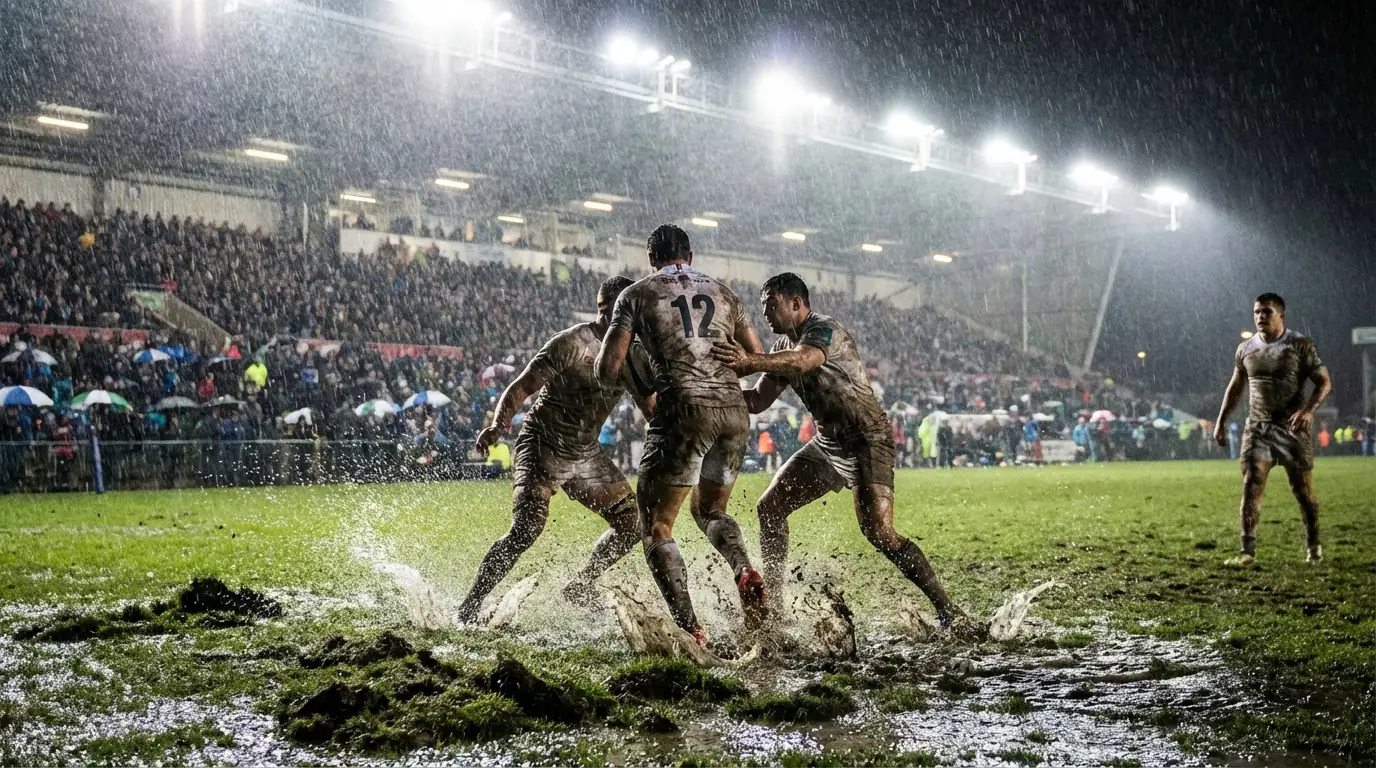
Rugby union is an outdoor sport played through the worst of the British and Irish winter, the windswept coastal stadiums of New Zealand, and the occasional downpour that turns a perfectly good pitch into something resembling a rice paddy. Unlike sports played on controlled surfaces or under retractable roofs, rugby is fully exposed to the elements — and the elements have a measurable, repeatable impact on match outcomes that most bettors don’t account for properly.
The bookmakers set their lines days before kickoff, typically based on expected conditions and historical averages. But weather is dynamic. A forecast that showed clear skies on Wednesday might show persistent rain by Friday evening. The odds shift slowly in response, if they shift at all, because the recreational market isn’t watching the Met Office with the same intensity as it’s watching team news. That lag between the weather forecast updating and the market adjusting is where weather-aware bettors find their edge.
This isn’t about becoming an amateur meteorologist. It’s about understanding a few fundamental relationships between weather conditions and rugby match dynamics, then incorporating that information into your existing analysis. The effects are most pronounced in two markets — totals and handicaps — and the principles are straightforward enough to apply consistently without adding excessive complexity to your process.
Rain: The Great Equaliser
Rain is the single most impactful weather variable in rugby union. A wet ball is harder to catch, harder to pass accurately over distance, and harder to kick with precision. The knock-on rate increases, lineout throwing becomes less reliable, and the scrummage becomes both more important and more unpredictable as forwards struggle for footing. All of these effects suppress scoring and compress the difference between teams of unequal quality.
The statistical evidence is clear. Matches played in persistent rain produce fewer tries on average, and the total points tend to cluster in the low-to-mid range regardless of the teams involved. A fixture between two expansive, high-scoring sides that might produce 50-plus points in dry conditions can easily land in the low 30s or even the 20s when the surface is saturated. The game reverts to its most basic elements: territory, set-piece dominance, and the boot. Teams that play a kicking-based territorial game gain a relative advantage, while sides that rely on width and offloading through the hands are disproportionately affected.
For totals betting, the implication is straightforward: rain pushes you toward the under. But the degree of adjustment matters. Light drizzle that starts in the second half has a smaller effect than heavy, persistent rain that begins before kickoff and saturates the pitch. The timing and intensity of rainfall matter more than the binary question of whether it rains at all. Check hourly forecasts rather than daily summaries, and pay particular attention to conditions in the two hours before kickoff, because a pitch that’s already waterlogged before the game starts has a much larger impact than rain that arrives at half-time on a previously dry surface.
The handicap implications are equally important. Rain compresses margins. A team that might win by 20 points in dry conditions will often win by 10 or fewer when conditions deteriorate, because the inferior team’s weaknesses in skill execution are partially masked by both teams making more errors. If you see a heavy favourite laying double-digit points and the forecast shows sustained rain, the underdog plus the points becomes significantly more attractive. Rain doesn’t make bad teams good, but it makes the gap between teams smaller and less predictable.
Wind: The Invisible Hand on the Scoreboard
Wind is harder to quantify than rain but arguably more strategically significant for bettors. Strong wind directly affects kicking accuracy, which in rugby union influences goal-kicking, restarts, tactical kicking for territory, and high-ball contestability. A 30-mile-per-hour crosswind at a coastal ground can render an otherwise reliable goal-kicker fallible, and the points left on the field from missed penalties and conversions add up quickly.
The direction of the wind relative to the pitch matters enormously. A headwind reduces the range and accuracy of kicks, particularly from distance. Teams playing into a strong wind often adjust their strategy to avoid kicking penalties from beyond 35 metres, which means they need to work their way closer to the try line for points — a harder proposition that produces fewer scoring opportunities. The team with the wind at their backs, conversely, can kick from deeper positions and play a more territorial game, pinning the opposition in their own half with long touch-finders that gain 50 or 60 metres.
This creates a specific betting angle for first-half and second-half markets. In matches with significant wind, there’s often a pronounced scoring asymmetry between halves. The team that has the wind advantage in the first half may build a lead that the other team struggles to overturn even when the wind switches. Historically, teams that play with the wind first tend to outscore their opponents in that half by a wider margin than the opponents recover in the second half. The reasons are partly psychological — trailing at half-time after playing into the wind is demoralising even if you know conditions will improve — and partly tactical, because the team that led at the break can adjust their second-half approach to protect the lead with conservative territory management. See also home advantage.
Cold and Frost: The Forgotten Variables
Temperature doesn’t get the same attention as rain or wind, but cold conditions affect match dynamics in ways that matter for betting. Freezing or near-freezing temperatures make the ball harder and less grippy, increase the risk of handling errors, and reduce the effectiveness of spinning passes that travel through cold, dense air. Players’ hands stiffen, and the ball doesn’t sit as comfortably in the cradle of a receiver’s arms. The effect is similar to light rain: more knock-ons, more scrums, and a slower tempo.
Hard, frozen pitches also change the running game. Footing becomes unreliable on frost-hardened ground, which limits the agility of backs in the outside channels and makes sidestepping riskier. Conversely, fast, firm ground can favour teams with pace on the outside, as long as the surface isn’t frozen to the point where it becomes slippery. The distinction between a cold-but-firm surface and a frozen-and-treacherous one matters, and it’s a distinction that the totals market rarely makes.
The practical takeaway is narrow but useful: when temperatures drop below 5 degrees Celsius and the ground is hard, expect handling error rates to rise and scoring to dip slightly below the seasonal average. It’s not a dramatic effect, and it’s not enough on its own to justify a bet, but layered on top of other factors — a team that relies on offloading, a total points line that looks generous — cold conditions can tip the balance toward the under.
Building Weather Into Your Process
The question isn’t whether weather affects rugby matches — that’s beyond dispute. The question is how to incorporate weather information into your betting process without overthinking it. The goal is a lightweight system that adds value without consuming disproportionate time.
Start with the forecast 24 to 48 hours before kickoff. Daily summaries are insufficient; you need hourly breakdowns that cover the match window. Reliable sources include national meteorological services for the country hosting the match. For UK and Irish fixtures, the Met Office and Met Eireann provide detailed hourly forecasts. For southern hemisphere matches, check the Bureau of Meteorology in Australia, MetService in New Zealand, and the South African Weather Service. These are free, authoritative, and more reliable than generic weather apps.
Focus on three variables in order of importance:
- Rainfall intensity and timing — persistent rain before and during the match has the largest effect; brief showers mid-game have a smaller impact
- Wind speed and direction — sustained winds above 25 km/h materially affect kicking accuracy and territorial play; gusts matter less than sustained speed
- Temperature — relevant only at extremes, primarily below 5 degrees Celsius or above 30 degrees, where player performance and ball handling are noticeably affected
Once you have the forecast, apply a simple adjustment framework. For totals, shift your assessment down by 5 to 10 points for heavy rain, 3 to 5 points for strong wind, and 2 to 3 points if both are present simultaneously. For handicaps, compress your expected margin by 20 to 30 percent in wet conditions. These are rough guidelines rather than precise formulas, but they’ll keep you on the right side of the market more often than ignoring the weather entirely.
The most important discipline is to check the weather after you’ve formed your initial view on a match but before you place the bet. Form your opinion on the likely result and the fair line based on team quality, form, and matchup dynamics. Then overlay the weather. If the weather supports your position, proceed. If it contradicts it — you liked the over, but heavy rain is forecast — either adjust your stake, look for a different angle, or pass on the match entirely. Weather should refine your decisions, not make them for you.
The Grounds That Punish You for Ignoring the Forecast
Not every rugby venue is equally affected by weather. Some grounds are sheltered by surrounding stands that block wind. Others sit exposed on coastal plains or hilltops where conditions are amplified. Knowing which venues are weather-sensitive and which are relatively protected is the final piece of the puzzle.
In the northern hemisphere, Thomond Park in Limerick is notoriously wind-affected, with swirling gusts that can make goal-kicking an adventure. The Stoop in London and Sandy Park in Exeter are also exposed to weather in ways that larger, enclosed stadiums like the Aviva in Dublin or the Principality in Cardiff (which has a roof) are not. In the southern hemisphere, Wellington’s old ground was legendary for its wind, and Dunedin’s Forsyth Barr Stadium — one of the few covered venues in world rugby — eliminates weather as a factor entirely.
The bettor’s advantage here is simple: when a weather-sensitive fixture takes place at a weather-exposed venue, the combined effect is larger than the market typically prices. A match in Limerick with 40 km/h winds is not the same as a match in Cardiff with the roof closed, even if the two teams involved are identical. The market treats venue as a secondary consideration, but for weather-impacted betting, it’s the multiplier that determines whether conditions are merely noteworthy or genuinely decisive.
Build a shortlist of the ten or twelve venues in the competitions you bet on, note which are exposed and which are sheltered, and cross-reference that list with the forecast every matchday. It takes five minutes. Those five minutes, applied consistently across a season, will save you from bad bets and steer you toward good ones that the rest of the market isn’t seeing. Weather impact rugby on rugby union betting.
