

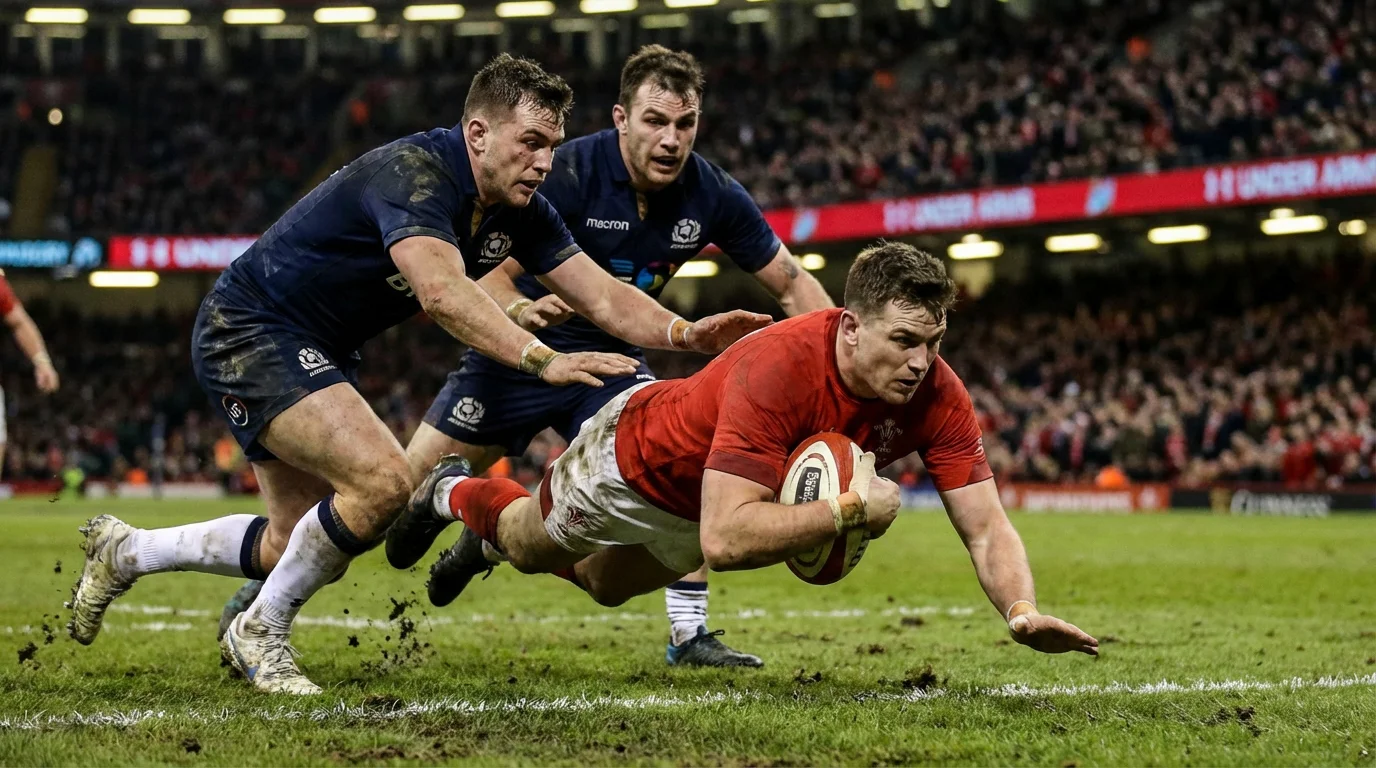
There is something satisfying about a bet that does not require you to pick a winner. Over/under betting in rugby union strips the contest down to a single question: will the combined score finish above or below a line set by the bookmaker? You do not care who lifts the trophy. You care whether the ball crosses the try line often enough — or not. It is one of the most popular markets in rugby, and one of the most misunderstood.
How the Totals Market Works
The bookmaker sets a line — say, 44.5 points for a Premiership match between Saracens and Harlequins. You bet over if you think the combined final score will be 45 or more, under if you think it will be 44 or fewer. The half-point eliminates any possibility of a push, which means every bet settles as a win or a loss.
Most sportsbooks offer a standard line with odds close to evens on both sides, typically around 1.90 to 1.95 in decimal. The slight discount from 2.00 on each side is where the bookmaker takes their margin. But the real action is in how that line is set and whether it accurately reflects the scoring dynamics of the specific fixture.
Rugby union scoring is not as uniform as some bettors assume. A converted try is worth seven points, a penalty goal three, a drop goal three, and an unconverted try five. The possible score increments create clusters around certain totals. A low-scoring arm-wrestle between two forward-dominant packs might land between 20 and 30 combined points. An open, expansive fixture between two sides who play width-heavy rugby can blow past 60. The bookmaker has to thread a needle between these extremes, and they do not always get it right.
Beyond the standard line, most bookmakers offer alternative totals — higher and lower lines at adjusted odds. If the main line is 44.5, you might also see 34.5 at around 1.35 on the over and 3.20 on the under, or 54.5 at 2.80 on the over and 1.45 on the under. Alternative lines give you the flexibility to adjust your position based on conviction. If you are highly confident a match will be high-scoring but not quite confident enough to take the standard over, a lower alternative line offers reduced odds but increased probability of cashing.
Team Style and Scoring Patterns
The single most important factor in totals betting is understanding how the two teams in a fixture prefer to play. Rugby union sides broadly fall on a spectrum from attritional, set-piece-heavy teams to expansive, phase-play teams that look to shift the ball wide at every opportunity.
A match between two teams at the attritional end of the spectrum — think a classic encounter between a Munster side built around their maul and a Castres team that wants to kick penalties and run down the clock — will tend to produce lower-scoring affairs. The ball spends more time in the air, more time in scrums and lineout mauls, and less time in the hands of outside backs who finish tries. Penalty counts tend to be higher, but penalty goals only contribute three points at a time.
Conversely, a fixture between two sides committed to running rugby — say, a URC meeting between Leinster and the Stormers in conditions that suit handling — is far more likely to produce a scoreline north of 50 combined points. Both sides create and concede try-scoring opportunities because their defensive structures accept a degree of risk in exchange for offensive output.
The subtlety lies in mismatched styles. When an attritional side meets an expansive one, the result depends heavily on who imposes their game plan. If the expansive team dictates tempo, the total tends to go over. If the attritional side suffocates possession and territory, unders is often the play. Reading pre-match team sheets, coaching tendencies, and recent tactical adjustments gives you a significant edge in these matchups.
Weather: The Variable Most Bettors Underestimate
Rain does not merely dampen a pitch. It rewrites the entire scoring script of a rugby match. A wet ball is harder to pass, harder to catch, and far more likely to be kicked than run. Handling errors spike, turnovers increase in contact but decrease from dropped ball in open play because teams stop throwing ambitious passes. Kicking from hand becomes the dominant tactic, and the game compresses into a territorial battle fought between the two 22-metre lines.
The effect on scoring is dramatic and directional. Heavy rain almost universally suppresses totals. Historical data across major rugby competitions consistently shows that matches played in significant rainfall produce fewer points on average than those played in dry conditions. The drop is not trivial — it can be ten to fifteen points off the expected combined total in extreme conditions.
Wind is the more nuanced factor. A strong crosswind makes goalkicking unreliable from the touchline, which can reduce penalty goal conversion rates and therefore totals. But a strong following wind can encourage teams to run the ball from deep rather than kick, which can open up scoring opportunities that otherwise would not exist. The key is to consider wind direction in combination with each team’s tactical approach: a team with an elite goalkicker will still attempt penalties into a moderate headwind, while a team reliant on territorial kicking will adjust their strategy more dramatically.
Checking the weather forecast on match day is not superstition. It is due diligence. A fifteen-minute check of conditions two hours before kick-off can be the difference between backing an over at poor value and snapping up an under that the broader market has not yet adjusted to.
Competition Context and Referee Tendencies
Not all rugby competitions produce the same scoring environments, and treating them interchangeably is an easy way to leak money. The Six Nations, for example, has historically been a lower-scoring tournament than the Rugby Championship. Northern hemisphere test rugby tends to be more structured, more kicking-oriented, and more cautious in its approach, particularly when sides are playing away from home. Southern hemisphere test rugby, while increasingly tactical in recent years, still trends toward higher combined totals on average.
Club competitions show even wider variation. Premiership Rugby in England has gone through cycles of high and low scoring depending on the prevailing refereeing interpretations and law changes. The Top 14 in France is often a grinding affair where defences dominate and penalty goals account for a disproportionate share of scoring. The URC, with its mix of Irish, South African, Welsh, Scottish, and Italian sides, produces volatile totals because the stylistic mismatches between conferences are stark.
Referee appointment is another factor that sophisticated totals bettors track. Some referees are more permissive at the breakdown, allowing the attacking team to recycle possession quickly and sustain phases. Others penalise aggressively at the ruck, breaking up attacking momentum and producing penalty goal opportunities instead of tries. A referee who awards 18 penalties per match creates a fundamentally different scoring environment than one who averages 12. This information is publicly available — World Rugby and tournament organisers publish referee statistics — and yet most recreational bettors never look at it.
Finding Value in Alternative Lines
The standard totals line is where the bookmaker concentrates their modelling effort and where the odds are typically sharpest. But alternative lines are where the recreational bettor often finds better value, precisely because they receive less attention from professional bettors and the bookmaker’s pricing can be less efficient.
Consider a Premiership match where the standard line is set at 46.5. You have done your analysis and believe the match will produce around 55 points based on team form, conditions, and attacking intent. The over at 46.5 might be priced at 1.91, offering modest value against your estimate. But the over at 52.5 might be priced at 2.60, and if your model assigns a 45 percent probability to the total exceeding 52.5, that represents significantly better expected value per pound staked.
Alternative lines also allow you to structure bets that reflect the shape of your uncertainty. If you think a match is likely to be high-scoring but there is a meaningful chance the weather changes or a red card alters the complexion, you can take a lower alternative over at reduced odds as a safer play. If you are highly convicted and want maximum return, a higher alternative over at bigger odds concentrates your exposure. This kind of line selection discipline separates bettors who approach totals strategically from those who simply click “over” on the first number they see.
The Asian totals market deserves a mention here because it handles these alternative lines differently. Rather than half-point lines that force a binary outcome, Asian totals can include quarter-point lines — for example, over 44.25 or under 44.75. A bet on over 44.25 effectively splits your stake between over 44.0 and over 44.5. If the total lands exactly on 44, you lose half the bet and push on the other half. This structure provides more granular positions and is favoured by sharp bettors who want precise exposure.
See also handicap betting.
When the Market Overreacts
One of the most reliable patterns in rugby totals betting is the market’s tendency to overreact to recent results. If two teams played a 45-38 thriller the previous weekend, the line for their next match tends to shift upward even if the conditions, opponent, and context are completely different. The reverse is also true: a dour 9-6 affair inflates unders pricing in subsequent fixtures.
This recency bias creates opportunities. A team that scored 40 points against a porous defence last week might face a side with the best defensive record in the competition this week, but the totals line will still be slightly inflated by the memory of that high-scoring performance. Sharp bettors fade the noise and focus on the specific matchup conditions rather than the trailing scoreline.
Injury news is another area where the totals market can be slow to adjust. If a team’s primary goalkicker is ruled out late, the totals line should theoretically drop because penalty goal conversion rates are likely to fall. But the line often stays static until significant money moves it. If you are monitoring team announcements closely — and in rugby union, most squads are announced 48 hours before kick-off — you can sometimes get ahead of these adjustments.
A Different Way to Watch the Match
The underrated appeal of totals betting is how it changes the viewing experience. When you have backed the over, every scrum penalty turned down in favour of a lineout drive feels like momentum building in your favour. Every wide pass in the rain makes your stomach drop. You stop thinking about which team you want to win and start thinking about the pace and rhythm of the contest itself. Over/under betting on rugby union betting.
That shift in perspective is not just more enjoyable — it can make you a better analyst. When you watch rugby specifically through the lens of scoring dynamics rather than team allegiance, you start noticing patterns that most fans miss. You see how a substitution at loosehead prop changes the scrum, which changes the penalty count, which changes the scoring trajectory of the final twenty minutes. You notice when a side switches from running rugby to game management at the hour mark, and you understand exactly what that means for the remaining points likely to be scored.
Totals betting rewards the bettor who watches more rugby, thinks about the mechanics of scoring, and respects the conditions under which the game is played. It does not demand that you predict the unpredictable question of who will win. It asks you something slightly more answerable: how much rugby will actually be played?
